 Reviews



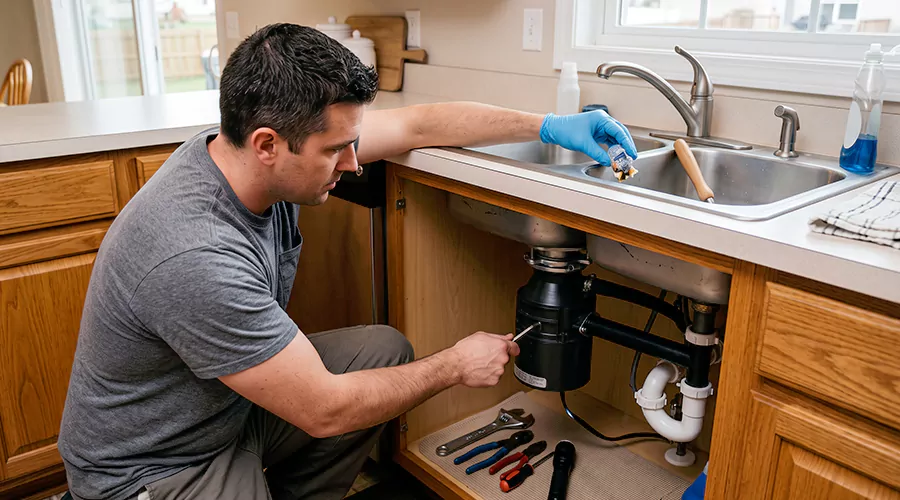
A garbage disposal that runs normally but leaves standing water in the sink usually has a blockage in the discharge outlet or connected drainpipe. The obstruction may be close enough to clear with a plunger, while deeper material may require P-trap cleaning or a drain auger.
This article focuses on restoring drainage rather than repairing the disposal's motor. Knowing how to unclog a garbage disposal starts with confirming that the appliance is actually grinding normally. This prevents unnecessary mechanical work when the real problem lies farther downstream.
Where Does a Garbage Disposal Drain Usually Clog?
A disposal discharges ground food and wastewater into the kitchen drainage system. Material can collect in several locations between the grinding chamber and the branch pipe.
Common blockage points include:
- Food residue near the disposal's discharge opening.
- Accumulated material inside the discharge elbow.
- Debris collecting in the kitchen P-trap.
- Grease buildup inside horizontal drainage piping.
- A restriction after the drains of a double-bowl sink join.
- An obstruction farther inside the kitchen branch pipe.
A blockage beyond the disposal will not necessarily affect the motor. The appliance may continue rotating while wastewater accumulates in the sink.
How Can You Tell Whether the Clog Is Inside the Disposal?
A simple observation can help distinguish a mechanical jam from a drainage restriction.
| Appliance Behavior | Possible Cause | Appropriate Next Step |
|---|---|---|
| Runs normally but water remains | Downstream drain blockage | Investigate drainage |
| Hums without rotating | Mechanical jam | Disconnect power |
| Does not start | Electrical or overload issue | Follow reset instructions |
| Second basin fills | Shared drain blockage | Check connected piping |
| Drains briefly before backing up | Partial restriction | Investigate the discharge and trap |
InSinkErator identifies a working disposal with continued standing water as a possible clogged-drain condition. Its troubleshooting guidance recommends appropriate plunging when a local drainage obstruction is suspected.
What Should You Do Before Unclogging the Disposal?
Electrical safety is the first priority. Turn off the disposal and disconnect its power supply before touching accessible components or working on connected plumbing. Remove excessive standing water when necessary. Place towels around the work area and clear stored items from beneath the sink.
Prepare these supplies:
- A flat cup sink plunger.
- A container for standing water.
- Protective gloves.
- A bucket.
- Suitable tools for accessible plumbing connections.
- A manual drain auger if deeper clearing becomes necessary.
Do not insert your hand into the grinding chamber. Use a flashlight to inspect visible material and appropriate tools when foreign objects need removal.
How Do You Unclog a Garbage Disposal With a Plunger?
A sink plunger can loosen a blockage located near the disposal's discharge or connected waste pipe. A double-bowl sink requires the unused opening to be sealed so pressure does not escape.
Use this method:
- Disconnect the disposal's electrical power.
- Remove excessive standing water.
- Seal the second sink opening when applicable.
- Leave enough water to cover the plunger cup.
- Position the cup over the disposal drain.
- Press downward slowly to establish a seal.
- Pull upward firmly without breaking the seal.
- Repeat several controlled strokes.
- Stop and observe whether drainage improves.
InSinkErator recommends approximately four inches of water for its plunging procedure and emphasizes a controlled downward movement followed by a stronger upward pull.
A sudden drop in the water level suggests that the obstruction has moved. However, additional testing is necessary to confirm that the drain is completely clear.
What If Plunging Does Not Work?
A blockage that does not respond to plunging may be inside the P-trap or farther into the connected waste pipe. Do not repeatedly operate the disposal to force water through the obstruction.
Instead, inspect the accessible drainage plumbing. A P-trap can collect solid food and grease. Removing it provides direct access to material that ordinary plunging cannot always reach. If the trap is completely clean, the obstruction may lie farther downstream.
How Do You Clean a Blocked P-Trap?
Cleaning the P-trap requires preparation because it contains standing wastewater.
Follow these steps:
- Disconnect the disposal's electrical power.
- Remove standing water from the sink.
- Place a bucket beneath the drainage connections.
- Identify the curved P-trap.
- Loosen its removable connections carefully.
- Lower the trap into the bucket.
- Remove trapped food or other material.
- Clean the inside of the trap.
- Inspect the washers and connection surfaces.
- Reassemble the drain and test for leaks.
The exact configuration varies depending on whether the kitchen has one basin, two basins or additional dishwasher plumbing. Avoid removing connections that you cannot safely identify or reassemble.
How Do You Clear a Deeper Garbage Disposal Drain Clog?
When the P-trap is clean but the sink remains blocked, a manual drain auger may help reach material inside the wall-side drain.
For accessible configurations:
- Remove the P-trap.
- Position the auger at the pipe entering the wall.
- Feed the cable forward gradually.
- Rotate the handle when resistance appears.
- Avoid excessive force.
- Withdraw the cable carefully.
- Remove captured material.
- Reassemble the drainage system.
- Perform a controlled water test.
Do not feed an unsuitable metal cable through the disposal's grinding chamber. Accessing the wall-side pipe allows the cable to bypass unnecessary internal appliance components.
Stop if the auger repeatedly encounters rigid resistance without progress.
Can the Dishwasher Cause a Disposal Drain to Back Up?
A dishwasher often connects to the garbage disposal's inlet. If the shared kitchen drain is restricted, dishwasher wastewater may enter the sink instead of leaving through the drainage system.
This behavior is particularly useful when diagnosing a problem that appears only during dishwasher operation.
Observe the following:
- Whether water backs up during the dishwasher's drain cycle.
- Whether the disposal side of the sink is already slow.
- Whether both sink basins are affected.
- Whether the dishwasher hose connection is secure.
- Whether the problem began after a new disposal was installed.
For a new installation, verify that the dishwasher inlet was configured according to the manufacturer's instructions. An inlet knockout plug that has not been removed can prevent the dishwasher from discharging properly.
How Do You Confirm the Disposal Drain Is Clear?
A successful repair should restore continuous drainage during normal kitchen use. Testing should occur only after the plumbing has been completely reassembled.
Follow this procedure:
- Run clean water into the sink.
- Inspect all accessible drainage connections.
- Increase the water flow gradually.
- Check the second basin when applicable.
- Confirm that no water backs up.
- Restore disposal power after all tools have been removed.
- Test normal disposal operation according to the manufacturer's instructions.
- Inspect the plumbing again for leaks.
A repaired drain should accept normal wastewater flow without creating standing water.
How Much Does Professional Disposal Drain Cleaning Cost?
A drainage obstruction does not automatically require appliance repair or replacement.
According to August 2026 U.S. pricing data:
| Work Required | Reported Cost |
|---|---|
| General professional drain cleaning | 147–352 |
| Average drain-cleaning project | Approximately $246 |
| Average garbage disposal repair | Approximately $230 |
| Average disposal replacement | Approximately $550 |
These figures describe different services. A simple drain obstruction may not require any work on the disposal itself.
When Should You Call a Professional?
Professional assistance is appropriate when accessible plumbing is clear but standing water remains.
Additional reasons include:
- Several connected fixtures are blocked.
- A manual auger cannot restore drainage.
- Water repeatedly backs up through the second sink.
- A dishwasher repeatedly discharges into the sink.
- Drain connections are damaged.
- The same blockage returns shortly after cleaning.
- The obstruction cannot be reached safely.
If the disposal motor also produces unusual sounds or repeatedly trips its overload protection, appliance troubleshooting may be required separately.
How Can You Prevent Disposal Drain Clogs?
Preventing drainage problems requires controlling the material entering the appliance and ensuring that ground food moves through the connected waste pipe.
Recommended habits include:
- Feed suitable food waste gradually rather than all at once.
- Keep hard and unsuitable objects out of the disposal.
- Never pour cooking grease into the appliance.
- Follow the manufacturer's cold-water recommendations during grinding.
- Continue running water briefly after operation.
- Avoid using the disposal when the connected drain is already slow.
- Investigate repeated backups before they become complete blockages.
Manufacturer guidance specifically recommends cold water during grinding and keeping grease out of the drainage system.
Conclusion
To unclog a garbage disposal, first confirm that the grinding mechanism operates normally. A running disposal with standing water often indicates a drainage obstruction rather than a motor failure. Begin with controlled plunging. Inspect the P-trap if the blockage remains and use a manual auger when the problem lies farther downstream. Persistent backups or problems affecting additional fixtures may require professional drain cleaning.
Frequently Asked Questions
Why does my disposal run but the sink remain full?
The connected discharge pipe or kitchen drain may be clogged.
Can you plunge a sink with a garbage disposal?
Yes. Follow the manufacturer's instructions and seal the unused sink opening when applicable.
Should I snake directly through the disposal?
The connected drainage pipe is generally a more suitable access point than feeding an ordinary metal cable through the grinding chamber.
Can the dishwasher cause water to back up through the disposal?
Yes. A shared drain restriction or incorrect dishwasher inlet configuration can interfere with drainage.
Does every clogged disposal require a plumber?
No. Some accessible drainage blockages can be cleared using appropriate household tools.